Research

Research directions

A readable map of the questions, concepts, and methods that connect the publications. The formal publication list remains separate.

What connects the work?

I study possible futures and the ways they are made thinkable. Sometimes the question is methodological: how should Delphi, narratives, scenarios, or scanning be used? Sometimes it is philosophical: what are possible futures, how can they be justified, and why are some alternatives difficult to conceive?
Where does it go?

The work goes through futures of work, science, universities, and historiography. I often develop concepts and methods rather than only applying existing tools. This is why the same publications can be read as futures research and as philosophy of science.

Research Radar

Work by others that helps to locate the field.

The Research Radar gathers selected readings around the same fields as my work. It is a small, curated extension of horizon scanning: recent and background work worth noticing, not a general news feed.

Open Research Radar

A source of examples

The Shining, It’s a Wonderful Life, Bob Dylan, rap, and sport

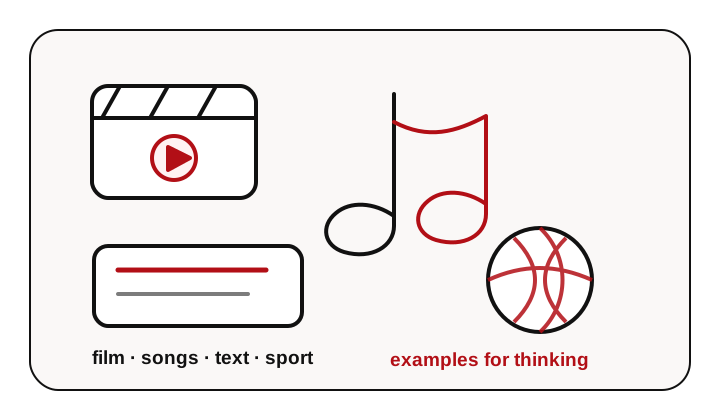
Line drawing of film, music, writing, and sport as sources of examples

Some examples and metaphors in my work come from films, songs, literature, rap, Bob Dylan, and sports. I do not use them as decoration only. They help to make pressure, timing, narrative, failure, choice, and strange turns visible in a way that purely technical language can miss.

Research craft and tools

Methods, concepts, and ways of working

Foresight method

Dialectic Delphi

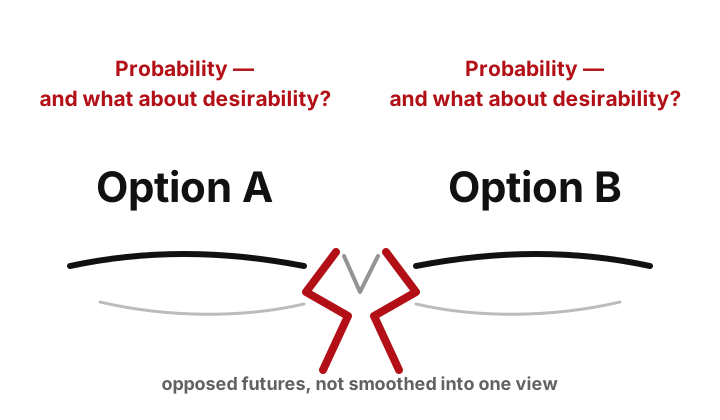
Rupture in the ground with option A and option B on different sides

I know and use Delphi in the wider sense, but dialectic Delphi is my own methodological development. In dialectic Delphi, opposing future directions are placed side by side. Participants assess probability and desirability, but also explain their reasoning. The comments are important because they show tensions, conditions, definitions, and trade-offs.

Read more

This is useful especially when the future issue is not a technical problem with one solution. University futures are a good example. People can want curiosity-driven research, public funding, and autonomy, but still think that market pressure, centralisation, or private funding may become more probable. The method helps to make such gaps visible.

See: “University futures: Insights from a dialectic Delphi study”.

Conceptual framework

Futures as space

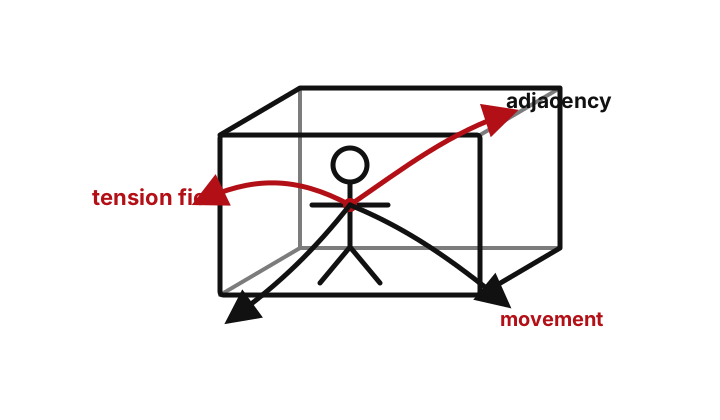
Three-dimensional box with a figure, arrows, and labels for tension field and adjacency

I think futures can often be understood better as a space than as a line. A space has dimensions, locations, distances, and possible movements. This way of thinking helps when we want to compare different possible futures without pretending that there is one simple path from the present to the future.

Read more

In futures of work, for example, the question is not only what tasks will exist. We can ask where work takes place, how technology is connected to labour, how work is measured, what kind of autonomy workers have, and how work relates to identity and community. These dimensions create a space where different work arrangements can be located and discussed.

See: Futures of Work: A Framework to Understand the Directions of Change; “The Greatest Mystery of Futures Studies: The Possibility Space as a Research Object”.

Narrative foresight

Narratives-with-branches

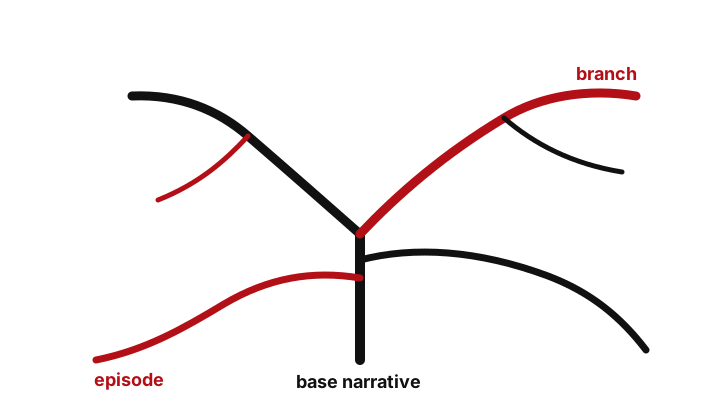
Simple tree drawing showing a narrative branching into possible futures

Narratives are useful because people do not live inside abstract trends. A narrative can connect systemic change with individual experience. In narratives-with-branches, a base narrative is developed through episodes that open different directions. These branches can be plausible, possible, or radical.

Read more

The method is especially useful in stakeholder work. Participants can react to a narrative, add episodes, change the direction of the story, and discuss what would make a future more desirable or more problematic. Narrative foresight then becomes not only communication, but a way to work with imagination and collective intelligence.

See: “The Next Episode for Narrative Foresight”; “Why and How to Use Narratives for Stakeholder Engagements?”

Philosophical programme

Philosophy of futures studies

I argue for philosophy of futures studies that starts from actual research practice. The point is not to float above the field in very general debates about time or possibility. The point is to clarify methods, concepts, assumptions, values, and knowledge claims that are already present in futures research.

Read more

This is philosophy of science applied to futures studies. It asks how futures knowledge or insight is produced, how methods are justified, how concepts such as possibility or plausibility work, and how different approaches can be improved. It can also ask what philosophical insights should be used inside futures studies, for example when thinking about desirable futures.

See: “The Shining: Illuminating Philosophy and Futures Studies”; “Tulevaisuus on filosofiaa! Mitkä ovat tulevaisuudentutkimuksen filosofiset peruskysymykset?”

CLA extension

CLA and futures of science

I connect Causal Layered Analysis with philosophy of science to study possible futures of science. The idea is that science should not be treated as one simple monolith. It has methods, values, institutions, metaphors, worldviews, instruments, and histories. These levels matter when we think about how science could develop.

Read more

Philosophy of science can work like a layered analysis of science. It can reveal assumptions behind science-related futures: which image of science is privileged, what is seen as progress, what is silenced, and which futures of science become thinkable. This approach also helps futures studies understand itself as a research field.

See: “Understanding Futures of Science: Connecting Causal Layered Analysis and Philosophy of Science”.

Conceptual caution

Limits of conceivability

Futures studies often assumes that we can imagine relevant alternatives if only we are creative enough. I think this is too optimistic. Some possible futures may be difficult to conceive from inside the present. This is not only a psychological problem. It can be conceptual, historical, and epistemological.

Read more

The problem can be seen through unconceived alternatives, leaking counterfactuals, and the difficulty of justifying alternatives that have not been actualized. These ideas show that the present can dominate our imagination. It follows that futures studies should study not only possible futures, but also the limits that shape what we are able to see as possible.

See: “Limits of Conceivability in the Study of the Future. Lessons from Philosophy of Science”; “On the Function and Nature of Historical Counterfactuals”.

Research craft

The base underneath: deep horizon scanning

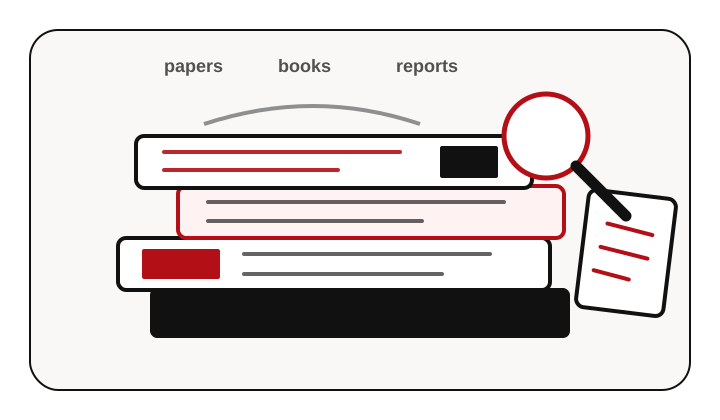
Pile of books, papers, and reports used for horizon scanning

The other methods still rest on careful horizon scanning of high-quality research literature, books, and reports. I do not understand scanning as collecting a few weak signals from short reports and news pieces. A good scan should create a serious knowledge base before concepts, scenarios, or methods are developed. In large projects this can mean working through hundreds of papers, books, and reports, so that futures thinking has enough depth behind it.

Read more

This scanning underlines many other methods. It helps to see which tensions are already in the literature, which concepts are confused, which futures are repeated too easily, and which alternatives are missing. It is also a way to respect the topic: if we discuss universities, science, or work, we should first understand what has already been studied with care.

See especially: Future Directions and Possibilities for the University; Futures of Work: A Framework to Understand the Directions of Change.

Core views

Core views in longer form

Short claims open into fuller notes, and each note points back to selected publications.

Delphi is not only a method for consensus.

I think Delphi is often too quickly understood as a method that tries to make people agree. This is not wrong, but it is too narrow. In futures research, disagreement can be valuable because it shows where people see tensions, trade-offs, and different meanings in the same future issue. A dialectic Delphi can make these tensions visible by placing different possible directions side by side. In this way, Delphi becomes a tool for structured thinking about disagreement, not only a tool for producing one shared view.

Read more

In university futures, disagreement is not noise. It can show that a future is desirable but not seen as probable, or probable but not desirable. It can also show that two apparently opposing futures are not simple opposites if definitions and implementation conditions are taken seriously.

See: “University futures: Insights from a dialectic Delphi study”.

The future of work is about arrangements.

I think futures of work should not be reduced to lists of future jobs or guesses about what people exactly will do. Of course tasks and professions change, but the deeper issue is how work is arranged. Where does work happen? How is it measured? What is the relation between worker, technology, organisation, place, and life outside work? When we look at work as an arrangement, we can understand many different futures without pretending that we already know which one will happen.

Read more

This is why dimensions and models are useful. They give a shared language for discussing differences between work arrangements. The future of work is not one thing. It is many possible movements inside a wider conceptual space.

See: Futures of Work: A Framework to Understand the Directions of Change; “When We Work”.

Narratives are useful because people do not live inside trends.

I think narratives are important in futures studies because they connect large changes with human experience. Trends, scenarios, and dimensions can show structures, but narratives show how a future might feel from inside. This does not mean that narratives are only communication tools. They can also help people think, react, disagree, and imagine branches from one possible future toward another. A good narrative can make a future more concrete without making it look like prediction.

Read more

Narrative foresight becomes stronger when it is not closed. A story can be opened with episodes, revised by stakeholders, and branched toward futures that are more preferred, more radical, or more uncertain. This is one way to connect psychological engagement and systemic change.

See: “The Next Episode for Narrative Foresight”.

Futures studies needs philosophy, but not every philosophical debate is equally useful.

I think the philosophy of futures studies should begin from the field as it actually works. It should ask what methods do, what concepts mean, what kinds of claims are made, and how these claims can be justified. Grand metaphysical questions about time and possibility can be interesting, but they do not automatically help futures researchers understand their methods better.

Read more

The useful philosophical work is often modest: clarify a concept, map assumptions, identify tensions between goals and methods, or develop a better conceptual tool. This is not less philosophical. It is philosophy close to research practice.

See: “The Shining: Illuminating Philosophy and Futures Studies”.

We should not assume that all relevant futures are easy to imagine.

Futures studies often encourages creativity and alternative thinking. This is good, but it can hide a deeper difficulty: the present may shape what we are able to conceive as possible. We may miss alternatives not because we are lazy, but because our concepts, histories, institutions, and evidential habits make some possibilities hard to see.

Read more

This makes the study of limits important. If we understand why some alternatives are unconceived, or why counterfactual histories leak the present into imagined alternatives, we also understand better what futures studies can and cannot do.

See: “Limits of Conceivability in the Study of the Future”.

Science also has futures.

We often discuss futures of technology, politics, climate, or work, but science itself is also changing. Its institutions, values, funding, tools, publics, and methods are not fixed. If science shapes society, then futures of science are not a side topic. They are central for understanding how knowledge, authority, and innovation may change.

Read more

Studying futures of science requires both futures methods and philosophy of science. We need to know how science has been understood, what assumptions are hidden in different images of science, and how alternative futures of science can be made visible.

See: “Understanding Futures of Science”; “The Philosophy of the Future of Science”.

Imagination and examples

Films, songs, Bob Dylan, rap, and sports

Line drawing of film, music, writing, and sport as sources of examples

My research is academic, but I often find examples and metaphors outside academic writing. Films such as The Shining or It’s a Wonderful Life, songs, Bob Dylan, rap, and sports can reveal narrative, pressure, timing, failure, choice, and strange turns. They help to make abstract issues concrete.

I do not use them to make research decorative. I use them because futures research is about imagination, but imagination is not only fantasy. It is a way to notice relations, tensions, and alternatives that are otherwise easy to miss.

Keyword map

Search terms connected to the work

Veli Virmajoki futures studies futures research foresight strategic foresight Delphi dialectic Delphi Delphi methodology narrative foresight narratives-with-branches branching narratives radical futures possible futures plausible futures philosophy of futures studies philosophy and futures studies philosophy of science futures of science future of universities university futures futures of work hybrid work futures work arrangements horizon scanning deep horizon scanning Causal Layered Analysis CLA and philosophy of science limits of conceivability unconceived alternatives leaking counterfactuals historical counterfactuals possibility space futures as space conceptual engineering philosophy of historiography

Wider research landscape

Research Radar

My own work rests on broad scanning of research literature, books, and serious reports. The Research Radar extends this outward: it gathers selected work by others that is useful for thinking about futures studies, Delphi, narrative foresight, futures of work, philosophy of science, university futures, counterfactuals, and related fields.

The Radar is deliberately selective: public entries should be serious, relevant, and close enough to the questions that structure this site.

Open Research Radar